Research
 I am interested in computational astrophysics and cosmology, a field that is focused on understanding some of the biggest mysteries in our universe: from the Big Bang to the evolution and organization of matter and energy.
I became interested in the cosmos as a kid on one of my family’s camping trips. Laying under the stars at night next to our tent, my parents and sister searched for familiar constellations, while I wondered what was hiding between the bright dots. Science documentaries and books broadened my horizons and inspired me to think about what the universe is concealing. I imagined going to a black hole, standing on the brink of the event horizon, and seeing the thin line that separates the world we know from one that is hidden. I imagined traveling to the edge of the universe, then back to the Big Bang, and finally to a point before space and time even existed.
These past two years, I decided to try to answer some of my more targeted questions. We don’t understand the nature of nearly 85% of matter in our universe. Because it neither emits nor absorbs light, it is known simply as “dark matter.” Despite its invisibility, it exerts strong gravitational force. Over time, it has pulled ‘normal’ matter into a cosmic web of clusters, filaments, and walls, creating a geometry that reflects the history of the universe itself. Both projects below are about dark matter: in one I studied the structure that dark matter builds, and in the other I looked into an idea about what dark matter might be – black holes left over from the first moments after the Big Bang.
The two projects are a year apart. The earlier one is on primordial black holes. I looked at ten published constraints and used a spreadsheet to calculate how much dark matter this type of black hole could account for. The second project is on the cosmic web. I built an automated pipeline to extract and quantify the cosmic web from simulation snapshots. This required a topology library compiled from source, multi-gigabyte simulation snapshots moved over Globus, and a scripted visualization engine. A lot of what I learned that year came from tedious work: getting DisPerSE to compile, avoiding artifacts at the crop boundaries, and moving data that was too big to “just download.”
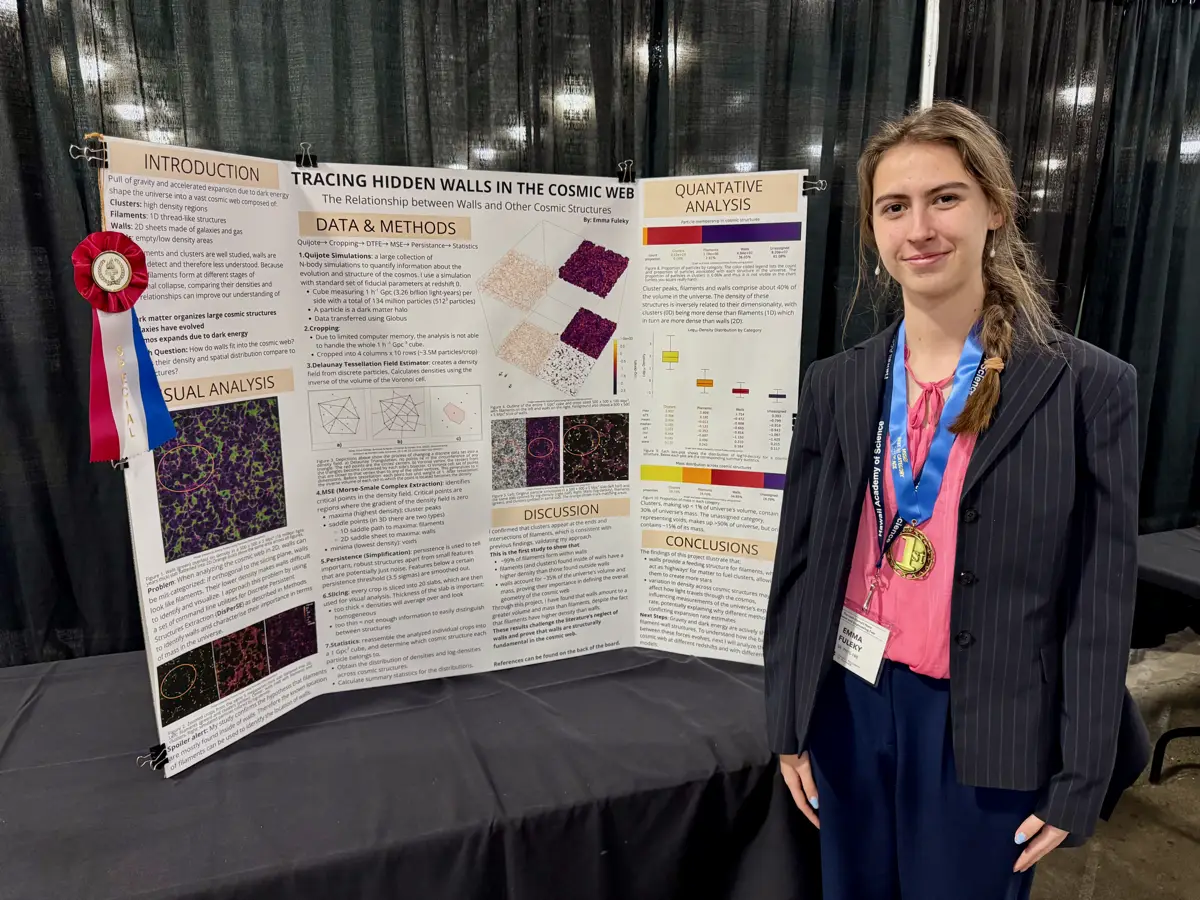
Disentangling the Cosmic Web 2026
The Relationship Between Walls and Other Cosmic Structures
- Finalist, Regeneron International Science and Engineering Fair (ISEF), Phoenix, AZ
- 1st Place, Physics and Astronomy, Hawaii State Science Fair
- Project website and full documentation (including video with highlights and 3D visualization)
- Project repo on GitHub
The question
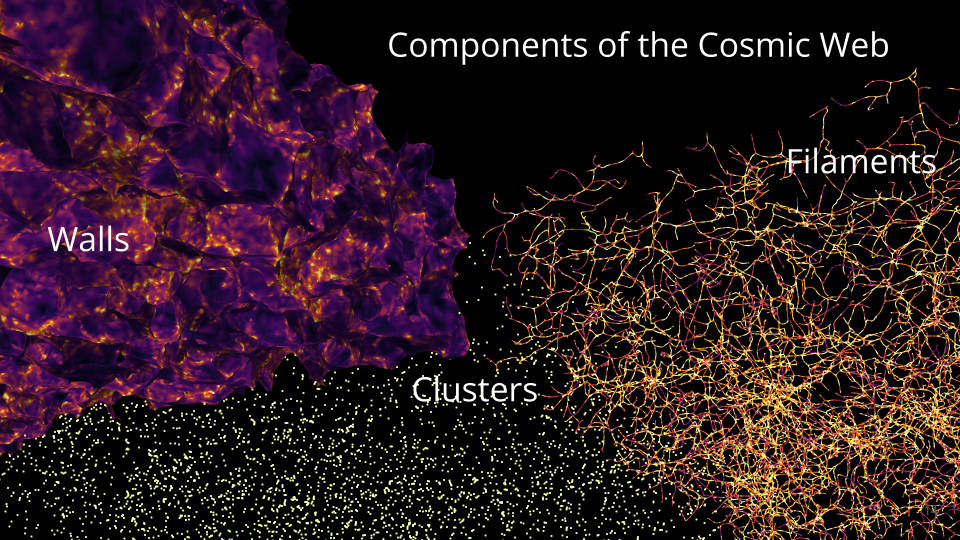
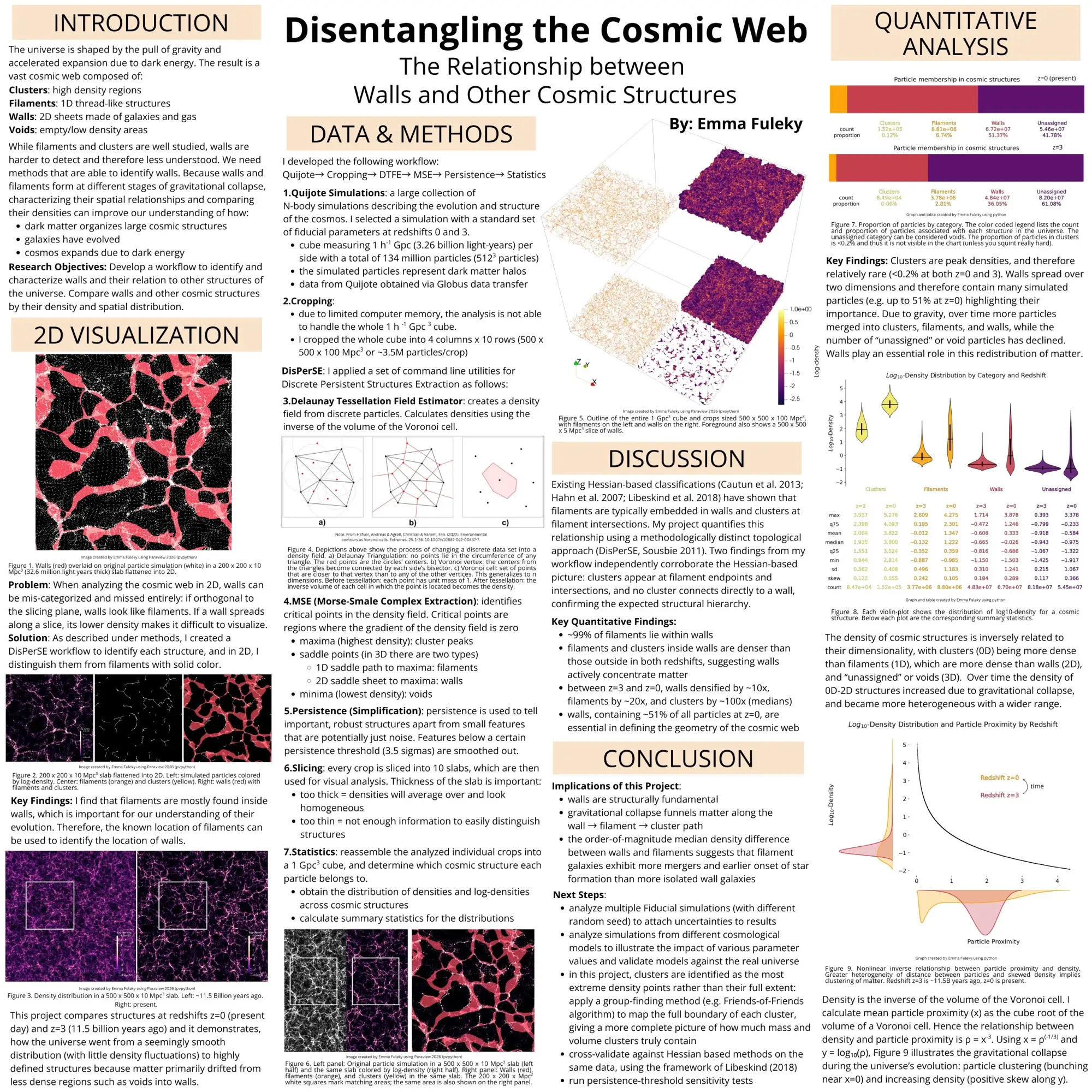
Gravity and the accelerating expansion driven by dark energy shape the universe into a vast cosmic web of clusters, filaments, walls, and voids. Filaments and clusters are well studied, but walls – two-dimensional sheets of galaxies and gas – are diffuse, easily mistaken for filaments in two-dimensional slices, so we know much less about them. Because walls and filaments form at different stages of gravitational collapse, comparing their densities and spatial relationships can tell us how dark matter shapes the largest structures, and how galaxies evolve inside them.
How do walls fit into the cosmic web, and how do their density and spatial distribution compare to those of other structures?
The approach
I built an automated pipeline (Quijote -> cropping -> DTFE -> Morse–Smale extraction -> persistence filtering -> statistics) that takes raw simulation snapshots and returns measurements and images of the cosmic web.
- Data. A Quijote N-body simulation with fiducial cosmological parameters at redshifts z = 0 and z = 3: a cube \(1 h^{-1} Gpc\) per side (\(\approx 1.5 Gpc\), or about 4.9 billion light-years) containing 134 million particles (\(512^3\)), transferred via Globus.
- Cropping. The full cube exceeds available memory, so I tiled it into \(4 \times 10\) crops of \(500 \times 500 \times 100\) \(Mpc^3\) (\(\approx 3.5\) million particles each). Then I rebased the coordinates in each crop and applied periodic tessellation to avoid boundary artifacts.
- Density field. A Delaunay Tessellation Field Estimator converts discrete particles into a continuous density field, using the inverse Voronoi cell volume as the density at each point.
- Topology. Morse–Smale complex extraction (DisPerSE) locates critical points in the density field: maxima are clusters, 1D saddles trace filaments, 2D saddles trace walls, and minima mark voids. Persistence filtering at a \(3.5\sigma\) threshold separates robust structures from noise.
- Statistics. Per-crop results are reassembled into the full simulation volume to determine which structure each particle belongs to, then aggregated into density distributions and summary statistics across all 40 crops.
What I found
- ~99% of filaments lie within walls. Because filaments are far easier to detect, their known positions can be used to locate walls.
- Walls contain ~51% of all particles today (at redshift: z = 0), and are therefore fundamental to the geometry of the cosmic web.
- Density scales inversely with dimensionality: clusters (0D) are denser than filaments (1D), which are denser than walls (2D), which are denser than voids (3D).
- Filaments and clusters embedded in walls are denser than those outside them, indicating that walls actively concentrate matter.

- Between z = 3 and z = 0, median densities rose \(\sim10\times\) in walls, \(\sim20\times\) in filaments, and \(\sim100\times\) in clusters, while the unassigned (void) population declined – matter drains from voids into walls and is funneled along a wall -> filament -> cluster path.
- The density gap between walls and filaments suggests that filament galaxies should show more mergers and an earlier onset of star formation than more isolated wall galaxies.
Two of my results reproduce what earlier studies found by a different route: clusters appear at filament endpoints and intersections, and no cluster connects directly to a wall. That earlier work uses Hessian-based classification, which identifies structures from local curvature (Hahn et al. 2007; Cautun et al. 2013; Libeskind et al. 2018); my pipeline is purely topological (DisPerSE; Sousbie 2011). Because the two methods work so differently, their agreement gives me real confidence in the pipeline. Full references are on the project site.
Tools
Python (NumPy, SciPy, h5py, Polars, Matplotlib) \(\cdot\) DisPerSE \(\cdot\) ParaView / pvpython \(\cdot\) Globus \(\cdot\) Quarto \(\cdot\) Git/GitHub
Next steps
I built the pipeline to be re-run with different inputs, so there’s a lot I still want to try:
- Attach uncertainties. Re-run the analysis across multiple fiducial simulations with different random seeds, to put error bars on the density and membership statistics.
- Vary the cosmology. Apply the same pipeline to simulations built from different cosmological models, to find which parameters the wall statistics are sensitive to and how well each model matches the observed universe.
- Measure whole clusters. Add a Friends-of-Friends group finder so clusters are mapped as extended objects rather than single density peaks, giving a truer account of how much mass and volume they actually hold.
- Cross-validate the method. Run a Hessian-based classification on identical data, following the framework in Libeskind et al. (2018), to quantify where the two approaches agree and where they diverge.
- Test robustness. Sweep the persistence threshold to confirm the results are not an artifact of the \(3.5\sigma\) cut.
Primordial Black Holes and Dark Matter 2025
The Link Between the Early Universe and Modern Cosmology
- Finalist, Hawaii State Science Fair
The question
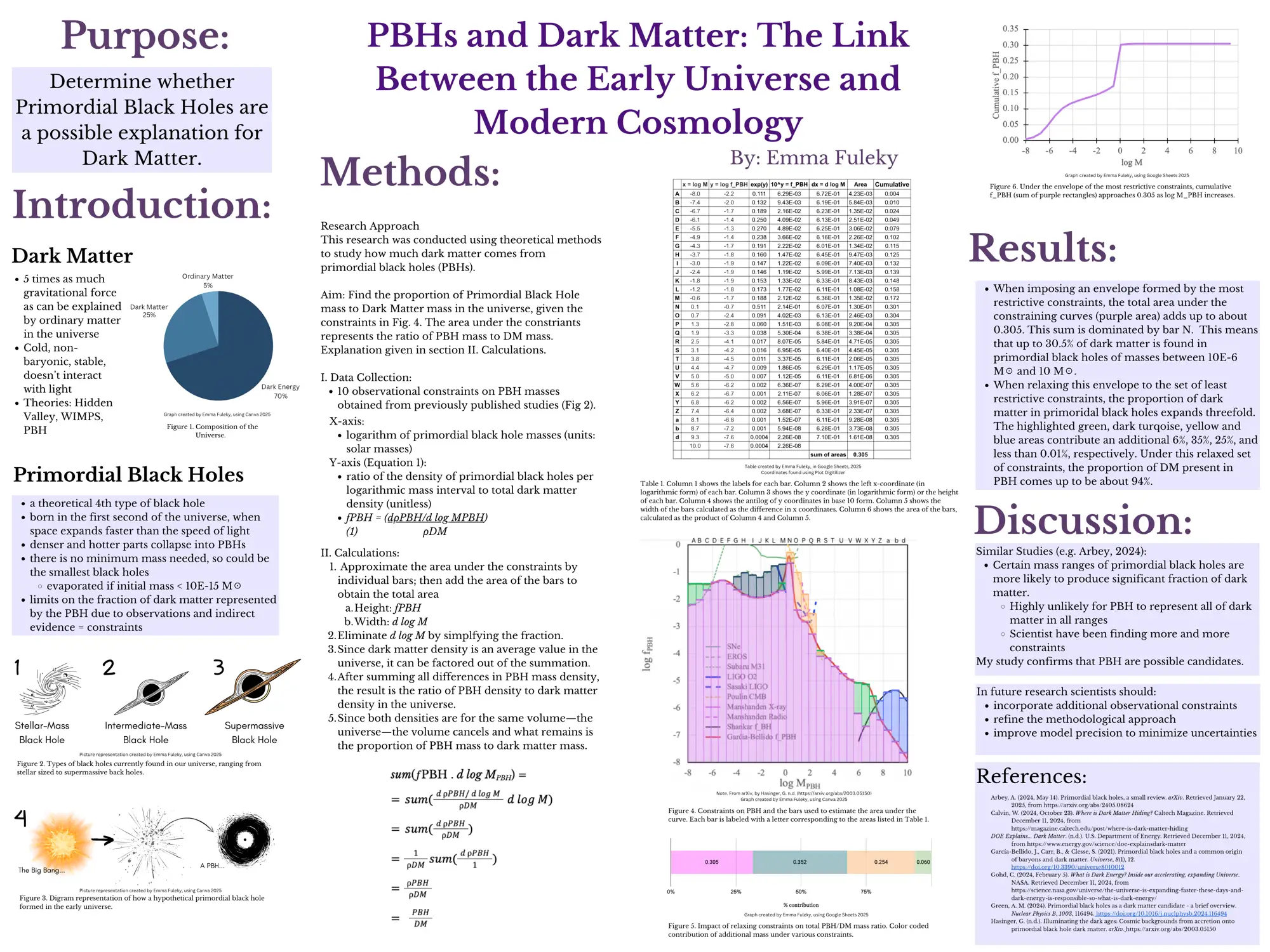
Dark matter exerts roughly five times the gravitational force that ordinary matter can account for, yet it is non-baryonic, stable, and does not interact with light. Primordial black holes (PBHs) – hypothetical black holes formed in the first second after the Big Bang, when denser and hotter regions collapsed directly rather than through stellar evolution – are one proposed explanation. Unlike stellar black holes, they have no minimum mass.
Can primordial black holes account for dark matter, and if so, what fraction?
The approach
I compiled ten observational constraints from the published literature. Each constraint limits \(f_{PBH}\) — the ratio of PBH density to dark matter density — at a given PBH mass. Plotting them against log mass, I approximated the area under the lowest curve with rectangles (height \(f_{PBH}\), width \(d \log M\)) and added them up. Since both densities are measured over the same volume, that sum is the fraction of dark matter directly.
What I found
- Under the most restrictive envelope of constraints, cumulative \(f_{PBH}\) converges to 0.305 – up to \(\sim30.5\%\) of dark matter could reside in primordial black holes with masses between \(10^{-6}\) and \(10 M_\odot\).
- Under the least restrictive envelope, that proportion expands roughly threefold, to about 94%.
The result is consistent with reviews such as Arbey (2024): certain mass ranges are far more promising than others, and it remains unlikely that PBHs account for all dark matter across all mass ranges. Within current constraints, though, they remain viable candidates. Narrowing this down would take more observational limits and a more precise method than mine.
Tools
Google Sheets \(\cdot\) numerical integration \(\cdot\) literature synthesis